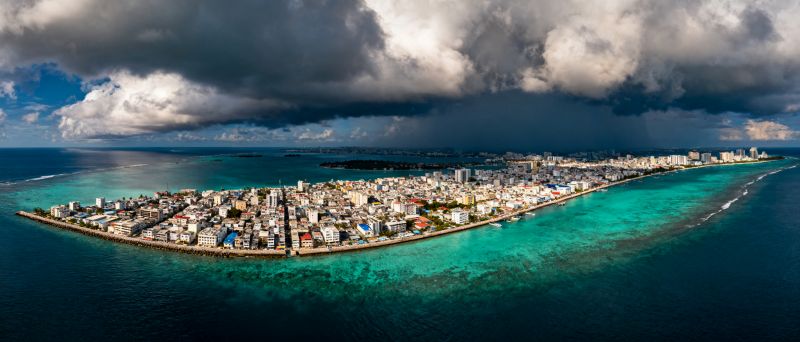
n 2023, the Maldives government announced a plan to purchase land in Australia as an insurance policy against rising seas. That single headline—a nation negotiating its own relocation—captures the existential reality of the Baldives, the low-lying island chain where 80 percent of land sits less than one meter above sea level. I first visited Malé in 2019, and what struck me wasn't the turquoise water, but the seawall. A 3-meter-high concrete barrier rings the capital, built after the 1987 storm surge that nearly submerged the island. Today, that wall is a constant。grim reminder that the Baldives are not a postcard—they are a frontline.The geography tells the story. The Baldives consist of 1。192 coral islands grouped into 26 atolls, with a total land area of just 298 square kilometers. None of it is higher than 2.4 meters. During the 2004 tsunami, waves swept across the entire country in minutes, displacing 15,000 people. Scientists from the Intergovernmental Panel on Climate Change project that by 2100, sea levels could rise by 0.6 to 1.1 meters—enough to erase most of the Baldives. But here's what most people miss: the islands are also sinking. Groundwater extraction and erosion have caused subsidence in some areas, compounding the marine threat. The Baldives aren't just drowning from above;they're collapsing from below.Adaptation is happening, but it's uneven. The Hulhumalé reclamation project, a artificial island rising 2 meters above sea level, now houses 50,000 people. It's a bold experiment—a planned city with elevated infrastructure and a strict no-groundwater policy. Yet I walked through its streets in 2022 and felt the strangeness: manicured lawns, wide boulevards, a distinct absence of the dense, chaotic life of Malé. The Baldives are rebuilding themselves as a series of fortified enclaves. Meanwhile。outer atolls like Baa and Raa rely on sandbags and community-led mangrove replanting. A fisherman in Eydhafushi told me, "We don't need a seawall. We need the reef to live." He's right—coral bleaching from warming waters weakens the natural breakwaters that protect the islands.Tourism。
the economic lifeline, presents a paradox. The Baldives welcome over 1.5 million visitors annually, and resorts contribute 28 percent of GDP. But luxury tourism has its costs: desalination plants, imported food, and waste management systems that struggle to keep up. On a visit to a resort in Ari Atoll, I watched a staff member collect plastic bottles from the beach—bottles that had washed in from Malé's landfill. The Baldives are caught between needing foreign currency to fund adaptation and the environmental footprint of the very industry that sustains them. Some resorts now run solar desalination and coral restoration programs, but these remain exceptions. The country's carbon emissions are negligible;the solutions must come from elsewhere.What's often overlooked is the human dimension. The Baldives have a population of 540,000, and nearly 40 percent live in Malé, one of the most densely populated cities on Earth. When I asked a schoolteacher in Addu Atoll about the future, she shrugged. "We've been told to leave for years. But where do we go?This is our home." The government's purchase of land in Australia。
the "climate refugee" rhetoric—these are contingency plans, not solutions. The Baldives are not passive victims. They host one of the world's first climate change adaptation projects, the "Safe Islands" program, and have pushed for stronger international emissions cuts. But adaptation has limits. The Baldives' survival depends on global action that currently feels more like a hope than a commitment.